

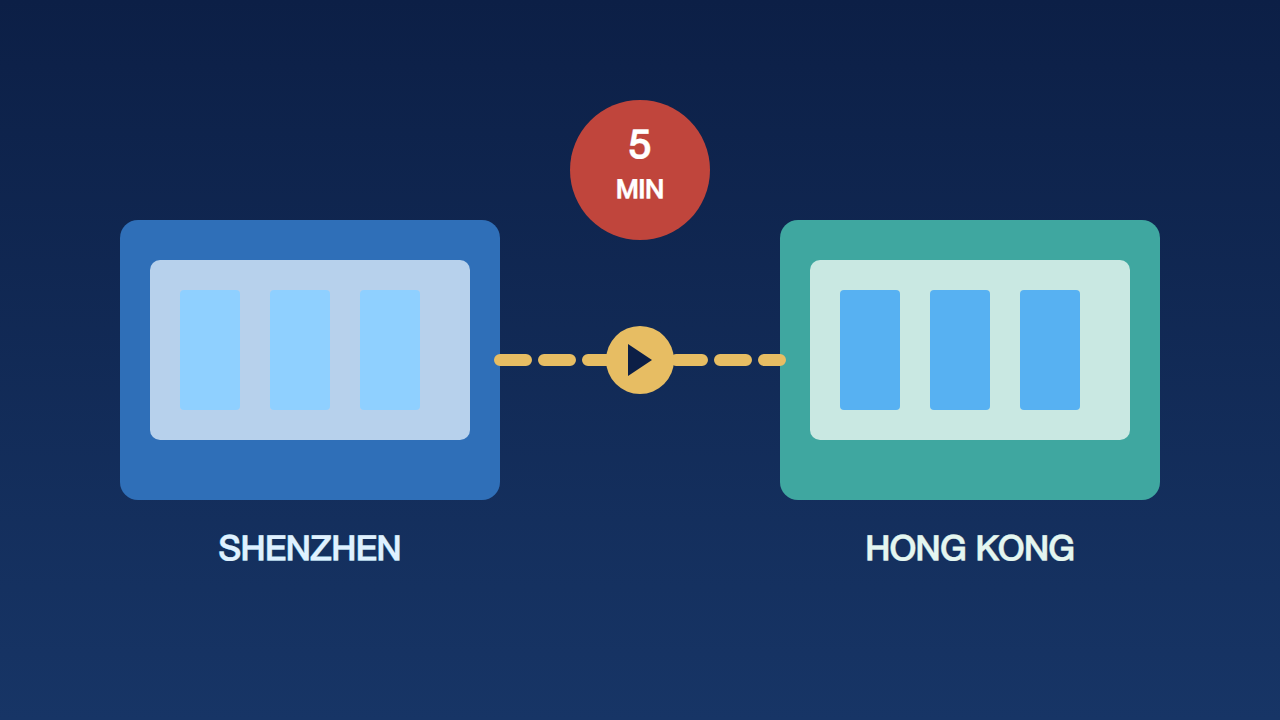
At 6:30 on the morning of 12 October, the first passengers walked into the rebuilt Huanggang Port. There was little ceremony; most were commuters pulling suitcases and business vehicles with dual licence plates. The change was concrete: the new port uses co-located immigration clearance, with both cities checking travellers in a single hall, cutting processing time from around 30 minutes to five.
A border crossing that was always a little different
Huanggang Port first opened in 1989 and is the only large land border between Shenzhen and Hong Kong that operates around the clock; anyone returning to Shenzhen after a late evening in Hong Kong, or heading to an early flight, knows it well. As cross-border volumes rose year after year, the old facilities became badly overstretched, and a rebuild on the original site began in 2019. The new complex covers 689,700 square metres, making it the largest single land-port building in the world.
The transport connections were rebuilt as well, with five rail lines and five bus routes feeding a multi-level interchange. From the port, passengers can reach popular commercial districts in 15 minutes and Huaqiangbei in three metro stops. For people used to treating the crossing as an intercity trip, it now feels more like changing lines within one city.
Integration is not a slogan; the ledger is specific
The first thing many people notice is easier commuting, but companies are keeping a different ledger. Hong Kong professional-services firms have been expanding northward for years, while Shenzhen technology and supply-chain companies use Hong Kong as a base for financing, intellectual property and international arbitration, and teams travelling between the two sides for a day of meetings is now routine. Faster clearance removes another slice of the time cost between the two cities, allowing tighter schedules for ad-hoc meetings, factory audits and sample inspections that used to reserve half a day for the border alone.
As people move more freely, documents move with them. Hong Kong incorporation papers, board resolutions, cross-border contracts, tender documents, notarised instruments and bank and audit materials flow across the Sham Chun River every day. Most require accurate bilingual wording, disciplined terminology and compliance with the distinct formats and notarial conventions of each side; the border now takes five minutes, but a single non-compliant document can hold up a cross-border deal for weeks. The language and paperwork gate is invisible, but it is no lighter than the customs one.
Faster clearance also changes how decisions get made
Cutting the crossing from half an hour to five minutes sounds like a saving of twenty-five minutes, but the real effect is on how companies arrange people and work. Meetings across the border used to be budgeted at half a day: the queues, the shuttle and the parking meant a morning meeting ate into most of a working day, and many conversations that could have happened face to face slipped into email and phone calls, while anything requiring a look at a sample or a production line was postponed again and again. Once the cost of the trip approaches that of an inner-city transfer, firms are more willing to send people to where the work is: Hong Kong designers coming north to follow a sample run, Shenzhen engineers attending standards briefings across the border, finance and legal teams making a day return for an account opening or a signing. These stop being exceptions and become routine.
As the rhythm of people changes, the services around them have to keep pace. For cross-border clients, the expectation on documents is shifting from “in a few days” to “can you do it today?”
A slow-moving opportunity for local services
Port economies are never only about restaurants and retail. As a Shenzhen translation company rooted in the city and handling Shenzhen-Hong Kong documentation for years, we have watched the mix of demand shift: trade documents used to dominate, while corporate-secretary papers, listing compliance material, cross-border legal documents and Hong Kong-style Chinese localisation now take a growing share, and clients increasingly value familiarity with the rules of both sides over raw speed.
It is too early to put a number on the new port’s impact, but the direction is clear: the physical border between Shenzhen and Hong Kong is thinning, and professional services that still operate as two separate worlds will slow the rhythm the port has accelerated. The documents we handle most often are set out in “After the Five-minute Crossing: the Bilingual Documents Behind Shenzhen-Hong Kong Business”, while translators eyeing this field should read “Greater Bay Area Translation Heats Up: Hong Kong-style Chinese, Notarised Papers and the Essentials for Newcomers”. For files in hand, see our document translation service. The old lesson still holds: borders can be redesigned in seven years, but a badly prepared document can freeze a deal on the day that matters most.