
On the evening of 6 October, the Royal Swedish Academy of Sciences announced that the 2026 Nobel Prize in Physics would go to Francis Halzen of the University of Wisconsin–Madison, cited for his decisive contributions to the IceCube Neutrino Observatory and the discovery of high-energy neutrinos of astrophysical origin. The 82-year-old Belgian-born scientist is this year’s sole laureate — but to read the story as a one-person achievement is to miss its most significant part.
The prize went to one person; the engineering belonged to 12 countries
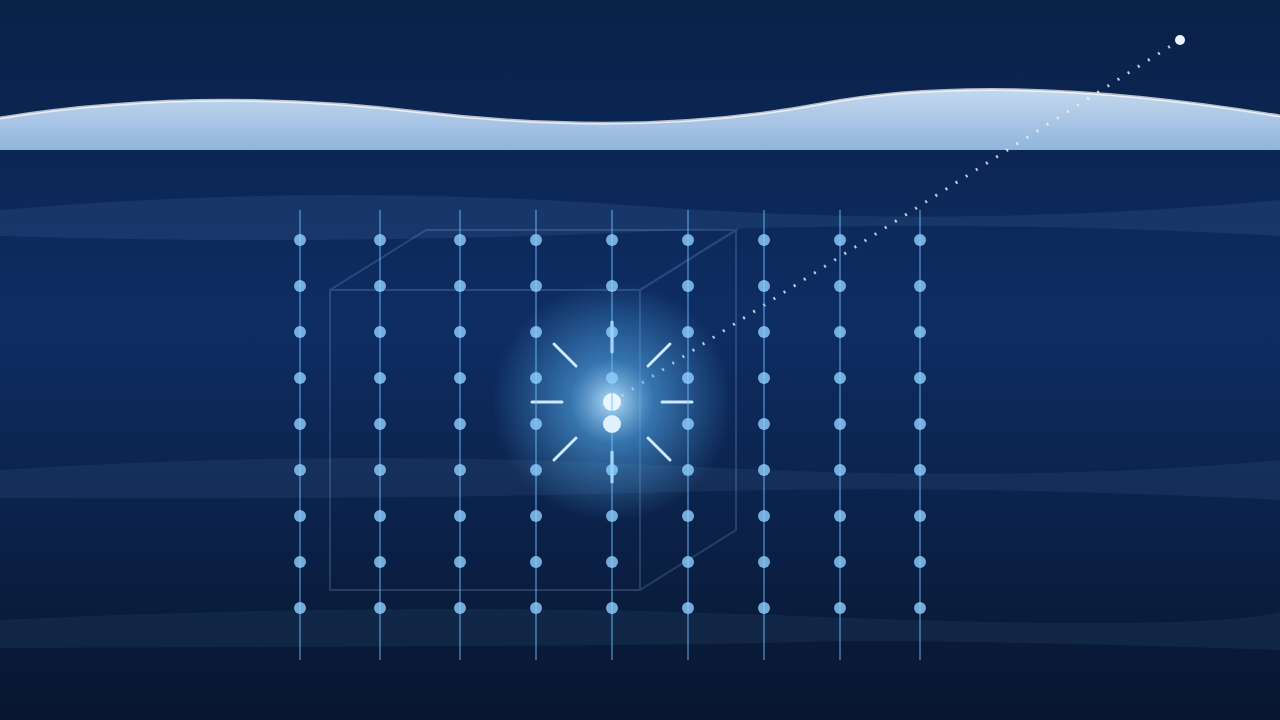
IceCube has no dome and no tube, and it does not sit above ground. Between 1,450 and 2,450 metres below the surface at the South Pole, 86 cables carry 5,160 basketball-sized optical sensors watching roughly a cubic kilometre of natural ice. Very occasionally, a high-energy neutrino strikes an atomic nucleus in the ice and produces a fleeting flash of faint blue light; the sensors record it, and researchers reconstruct the particle’s direction and energy.
Halzen first proposed using ice to detect neutrinos at a conference in Poland in 1988. Construction began in 2004 and the array was completed in 2011. Behind the facility stood 12 countries, more than 50 institutions and over 300 scientists and engineers. In 2013 the collaboration reported the first evidence for high-energy neutrinos from beyond the Solar System, and neutrino astronomy properly began.
Every stage of big-science collaboration crosses a language boundary
Collaboration on this scale does not run on equations alone. Grant proposals for funding agencies in different countries have to be prepared in the agencies’ own languages; design reports, safety manuals and construction specifications are repeatedly synchronised between English working drafts and national versions; papers require consistent terminology and agreed authorship conventions, while daily correspondence and meeting minutes cross languages all the time. Sensor models, depth parameters, units and abbreviations that fail to match across language versions can turn into engineering problems later.
China’s role is growing. The Nobel presentation singled out the next generation of neutrino telescopes — notably China’s Hailing project. Over this National Day holiday, Hailing’s first string prototype was deployed at a depth of more than 3,000 metres and connected to the South China Sea observation network; Xu Donglian of the Tsung-Dao Lee Institute at Shanghai Jiao Tong University was a member of the IceCube collaboration as a graduate student in 2009. Earlier, Cao Jun, director of the Institute of High Energy Physics, had hosted Halzen at the Jiangmen Underground Neutrino Observatory before it began taking data. Chinese researchers joining international experiments and Chinese facilities opening to the world are proceeding in parallel.

Research translation is becoming infrastructure
Research language services used to be regarded as a finishing touch, an English version of a paper prepared before submission. The pattern of demand has changed. On one side, the scale of Chinese research keeps rising, with papers, patents and grant applications handled in both directions. On the other, large-scale facilities are multinational by nature, with proposals, technical files and data documentation maintained in several languages over many years. Add open-access publishing and the routine place of international conferences, and academic translation is moving from a one-off purchase to a fixed stage in the research workflow.
Machines have a clear place in it: screening literature in bulk and processing repetitive technical material through machine translation post-editing is fast and economical. But the nuance of an argument, the accepted meaning of a term and the precision of numbers and units ultimately require finalisation by someone who understands the discipline. That is what separates this work from ordinary translation. How we run these projects is described in “How We Translate Research: Practical Lessons from Papers, Grant Proposals and Laboratory Documents”, while “Want to Translate Science? A Skill Checklist Drawn from the IceCube Story” is written for translators entering the field. If you have papers or research files in hand, our document translation page sets out the service.